


 Catherine McGloin
The Dangers of Being Black in Public
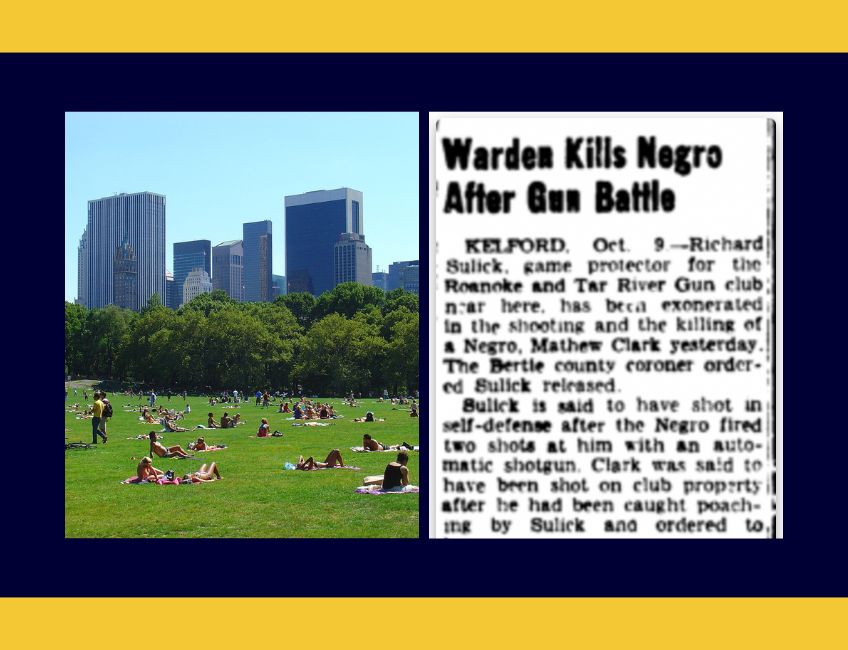
Central Park Birdwatcher incident part of historical continuum, new case investigated by CRRJ and released by Cold Case Review Board shows
Christian Cooper was birdwatching in Central Park when an unleashed dog crossed his path in an on-leash area. To contain the dog and protect the wildlife, Christian Cooper, a scientist and author, offered the dog a treat, prompting the animal’s owner, Amy Cooper (no relation), to grab her cell phone and begin screaming, threatening that she was going to call the police.
Christian Cooper filmed the incident on his cell phone and the video went viral.
What Christian Cooper’s experience revealed to many is something that Black birdwatchers, Black nature enthusiasts, and simply Black people in public spaces have known for decades: their mere presence is often unwelcome and can be perceived as a threat.
A case recently released by the National Archives and Records Administration (NARA) under the Civil Rights Cold Case Records Collection Act, and initially investigated by CRRJ’s historian Dr. Jay Driskell, exposes the historical continuum that exists between the treatment of African Americans in public spaces in the twentieth century, and Christian Cooper’s experience in 2020.
Presence as a Justification for Murder
On the morning of March 4, 1948, A. A. Stephens, a white woman, called the Georgia State Patrol to report witnessing an African American man acting suspiciously in front of her home in Lula, Georgia. Rev. Samuel L. Sawyer was examining the ground with magnifying glasses and allegedly observing the Stephens household with “field glasses.” When Troopers James Ned Beatty and Willis D. Greer arrived at the house to question Sawyer, they reported that he refused to cooperate with the police. Officer Greer grabbed Sawyer by the arm and demanded to talk to him, at which point Sawyer allegedly struck Greer in the head with the magnifying glasses. Officer Beatty helped Greer place Sawyer under arrest, forcing him into the patrol car. As the car began to drive away, Sawyer allegedly grabbed Greer’s blackjack and proceeded to beat him with it. During the altercation, Sawyer allegedly grabbed Greer’s gun, prompting Beatty to shoot Sawyer twice, killing him instantly.
Beatty faced no charges for killing Sawyer. Neither the FBI or the DOJ investigated the incident and the Troopers’ testimonies were never questioned.
Given Sawyer’s actions, staring intently at his surroundings with instruments designed for exploration, it is possible that he may have been birdwatching, or enjoying other aspects of nature. It’s possible that Sawyer, rapt with attention at what he may have been looking at when the police arrived, did not respond promptly enough, angering the officers who were accustomed to deference from Black men and Sawyer’s alleged attacks may have been in self-defense.
In Sawyer’s case, no questions were asked about his activity. Rather it was assumed, just by his presence that he posed a threat and thus officers responded with violence, costing Sawyer his life.
Sawyer’s case is one of three released by NARA onto the Cold Case Records Review Board’s new online portal. The review board — of which CRRJ Director Margaret Burnham is a member — is systematically examining government files from cases of historical racial violence and ensuring the release of previously digitally unavailable documents to the public. Included in this first release are the also the killing of Hattie DeBardelaben in 1945, first investigated by CRRJ more than a decade ago, and the case of Leroy Bradwell, killed in Georgia in 1946. Sawyer’s files were originally requested through the Freedom of Information Act by Driskell in January 2022.
Christian Cooper, whose book Better Living Through Birding: Notes from a Black Man in the Natural World was published in 2023, has emphasized the importance of positioning his experience in Central Park within the wider historical context of systemic racism in the United States.
Sawyer’s case and Christian Cooper’s experience demonstrate a continuum throughout history, that the presence of Black men and women in public spaces and the great outdoors is, by default, perceived as threatening to white people’s physical safety.
Many of the cases housed in the Burnham-Nobles Digital Archive highlight this aspect of the African American experience of racial violence.
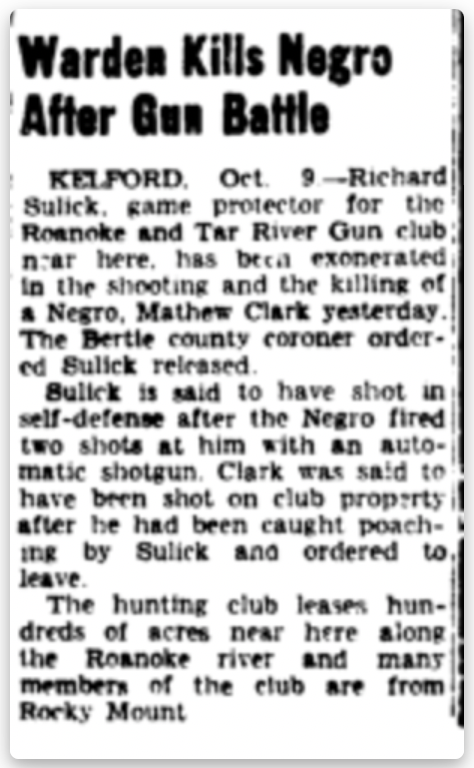
One such case is that of Matthew Clark, killed in 1941 while out hunting one fall morning in the woods outside Lewiston, North Carolina. Clark was shot by a watchman employed by the Big Field Hunting Club, who later alleged Clark was trespassing on private land and that he had shot Clark in self-defense. However, a private prosecutor found Clark was shot 14 times and his body had been moved from its original location to more than 500 yards in the woods. This suggests the watchman killed Clark before moving his body onto club-owned land to justify the shooting.
Either way, Clark’s mere presence was a threat that the watchman felt warranted extreme violence and unnecessary bloodshed.
Reclaiming Freedom
There are movements challenging these historically racist notions.
Following the birdwatching incident in Central Park, STEM professionals and students known as the BlackAFinSTEM collective, launched Black Birders Week in 2020. Now, each year the first week in June is dedicated to events highlighting Black nature enthusiasts, designed to increase the visibility of Black Birders, engage with Black leaders and experts in the birding community, and explore the intersection of birding, Black culture and environmental justice. The Smithsonian Institution and The National Museum of Natural History both support this annual event.
With the release of Sawyer’s case files, it is hoped that this violent history and the historical racism Black nature enthusiasts have faced can be more fully explored.
Read more...


Join our mailing list
Receive the latest news about CRRJ's work, events and programs.
By submitting this form, you are consenting to receive email communications from The Civil Rights and Restorative Justice Project https://crrj.org. You can unsubscribe any time by using the SafeUnsubscribe link found at the bottom of every email. Serviced by Constant Contact.