


 Catherine McGloin
 Vote Suppression, Franchise and White Supremacy: an American History

The 2020 presidential election triggered a wave of concerns and legislation regarding election integrity, voter suppression and the security of American democracy.
Over the last four years, states including Florida, Texas, Georgia and Mississippi have enacted several laws severely limiting access to the ballot box and voter registration organizing. In these states, navigating convoluted eligibility rules is as difficult and irksome as ever, but, increasingly, honest mistakes are sending citizens to jail.
In 2023, the Texas Senate passed a bill empowering the secretary of state to appoint “election marshals” to investigate election crimes, despite no evidence of increased election fraud in that state. Another bill, passed in 2023, removes the burden of proof on prosecutors looking to charge individuals for illegal voting.
Similarly, Georgia’s legislature has followed Florida’s lead and is establishing a unit to investigate election law violations, expanding the power of state criminal agencies to pursue these irregularities. Georgia’s Secretary of State’s Office investigation division has 23 sworn officers – many of whom, according to their website, are ex-law enforcement officers and detectives.
These bills make it easier for those with prior felony convictions — of which a disproportionate number are African American — to be prosecuted for voter fraud. They create an atmosphere of increased fear and intimidation when it comes to voting in certain districts.
But these political and legal maneuvers cannot be fully understood unless placed in their historical context. Violent racialized vote suppression across the twentieth century led to the civil rights reforms of the 1960s — including the Voting Rights Act. But, long after the adoption of these federal laws, ongoing campaigns — often subtle and sometimes violent — to limit the franchise to white Americans persist.
The Burnham-Nobles Digital Archive illuminates this pre-VRA history, and the cases contained therein, many of which are not well known, shed light on the history of violent vote suppression – the precursor and cousin to today’s practices.
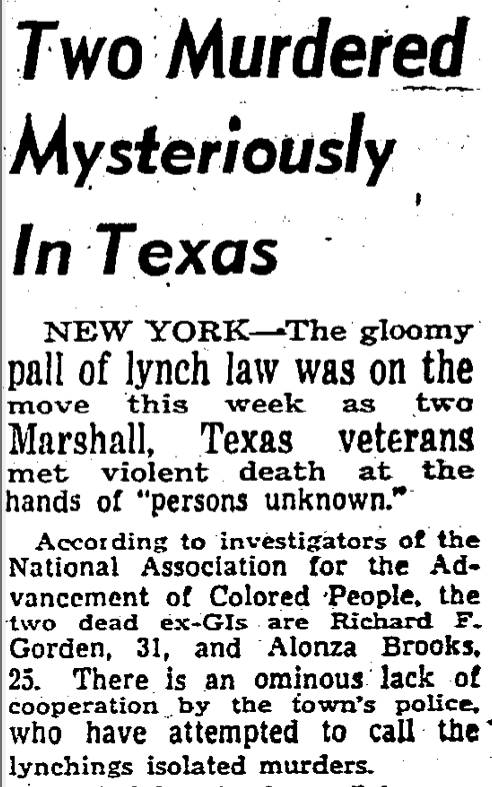
In Harrison County, Texas, Alonza Brooks, Jr., 25, and Richard Gordon, Jr., 31, were killed during the primary elections in 1946.
Although deemed a hit-and-run by police, witnesses stated that Gordon’s throat had been cut. Newspapers reported Gordon, a WWII veteran, was dragged through the main streets of Marshall behind a car. His body was found at the Port Caddo Baptist Church, July 28, 1946.
Some people in the community believed Gordon’s killers conspired with police, remaining at the scene until authorities arrived and later offering conflicting reports about where his body was discovered.
Folks in Marshall are wondering whether there is any connection in the deaths of these vets with the possible responsibility for the presence of MP’s at the polling places in Marshall during the July 27th primary. Perhaps the local “Gauleiters” objected to Negro ex-GI’s taking steps to ensure those voting rights they thought they were fighting a war to protect.”
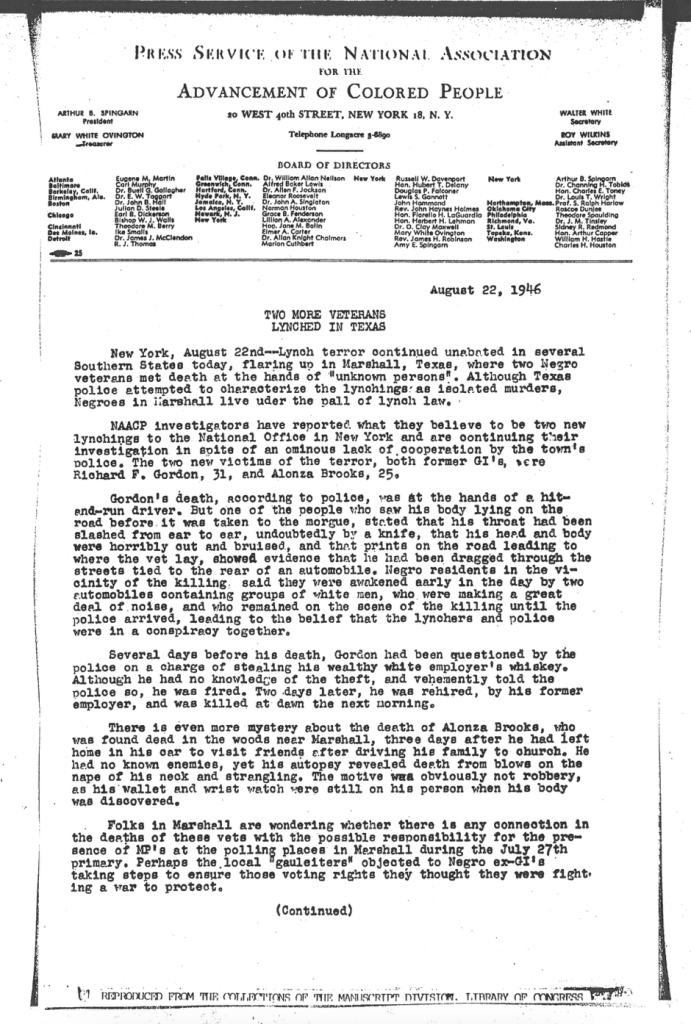
Brooks, a WWII veteran, was killed on August 13, 1946. His body was discovered in woodlands outside of Marshall, with blows to the neck and signs of strangulation.
Reportedly, their killings were a response by white residents in Marshall who resented the presence of Military Police and Black veterans, posted to protect Black voters and ensure their participation in the July 27, 1946 primary. This was the first statewide election after the Supreme Court ruled in Smith v. Allwright, a Texas case, that all-white primaries were unconstitutional.
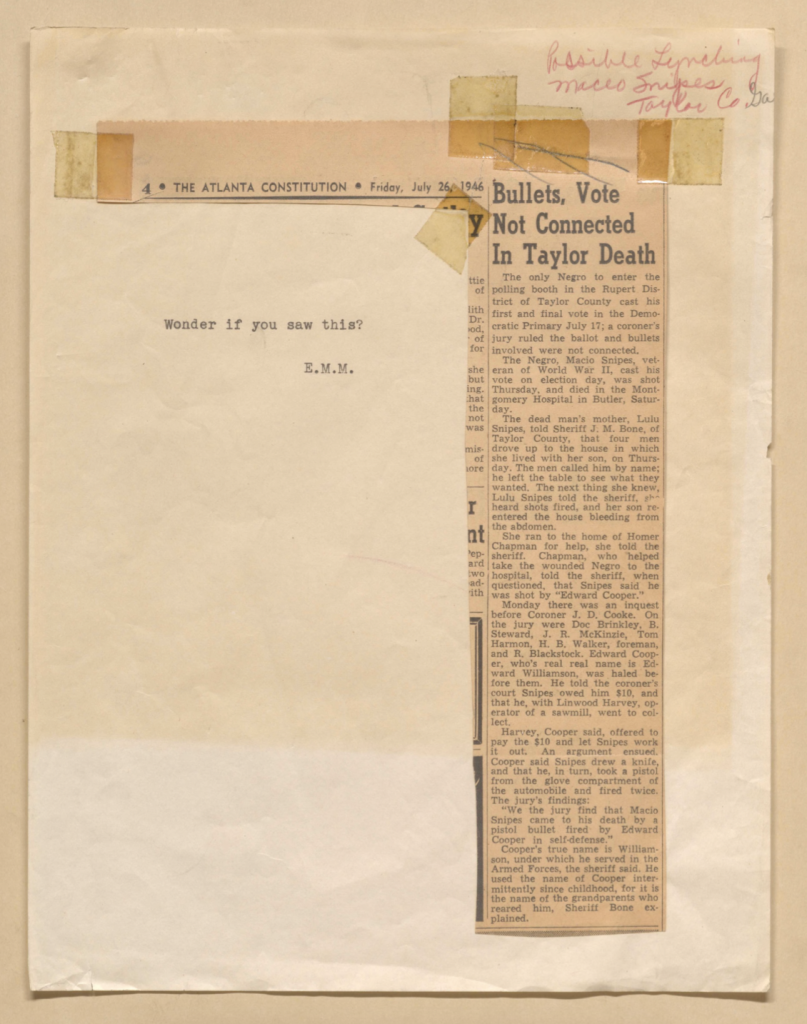
That same year in Georgia, Macio Snipes, also a WWII veteran, was the only Black person from the Rupert District to vote in the 1946 Georgia primary. He was killed on July 18 of that year by Edward Williamson in Taylor County.
According to newspaper reports, Snipes’ vote was considered a direct challenge to the plans of staunch segregationist Herman Talmadge, governor of Georgia from 1948 to 1955, and Georgia’s U.S. senator from 1957 to 1981. Talmadge openly aligned with white supremacist groups to maintain control over Georgia’s elections and “collaborated with members of the Ku Klux Klan to intimidate voters across the state,” reports the Atlanta History Center.
A group of white men arrived at Snipes’ home under the pretense they were there to collect a $10 debt. They shot Snipes to death on his own porch.
A member of the mob, Edward Williamson later testified that Snipes pulled a knife during the confrontation, and he shot Snipes in self-defense. No legal action was taken against Williamson or the other assailants. The case was briefly reviewed and closed by the FBI in 2010, under the Till Act.
Isaiah Nixon, a 28-year-old farmer and WWII veteran, was killed on September 8, 1948, in Montgomery County, Georgia. During Georgia’s primary election, Nixon went to a polling place and attempted to cast his ballot. Later that night, two white men, J. A. Johnson and his brother, went to Nixon’s house and shot him. The brothers were arrested and charged. They were later acquitted by the trial jury.
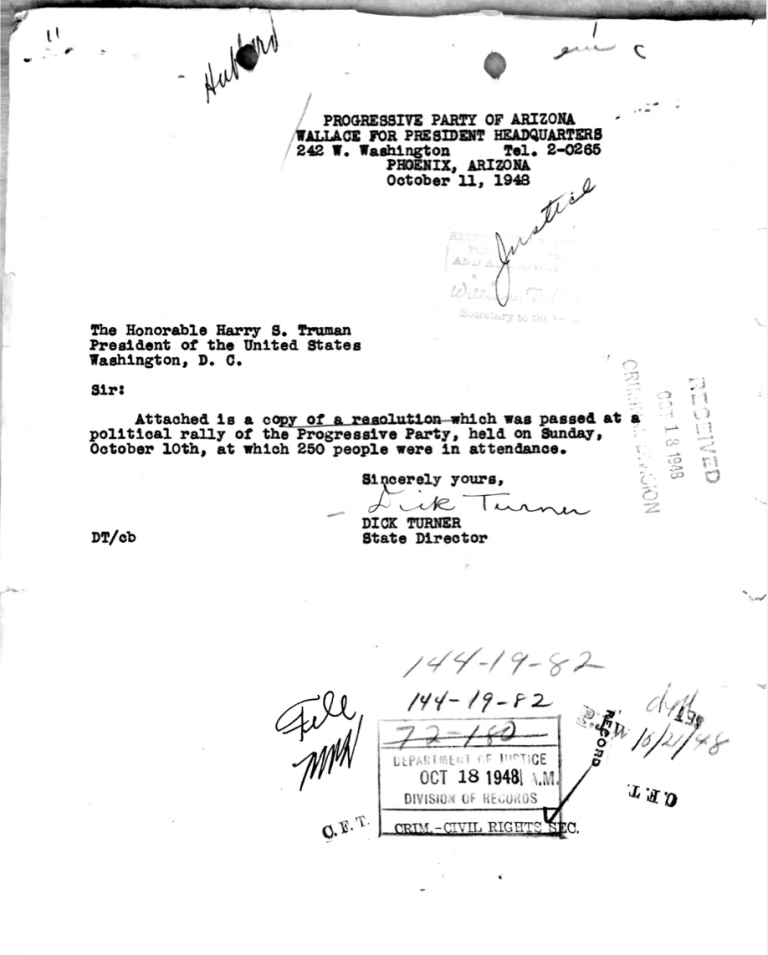
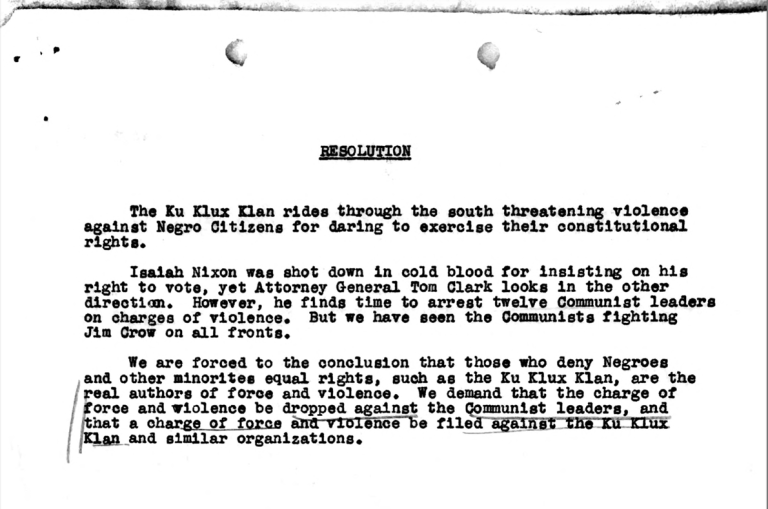
It must be noted that all four of these victims – Brooks, Gordon, Snipes and Nixon – were WWII veterans. Less than 12 months after the end of the war, all four would be dead, killed for exercising their democratic rights as citizens of the land of the free.
A defining feature of white supremacy, voting remains elusive for many people of color in the United States, particularly African Americans forced today to navigate systems designed to exclude them from the democratic process. The history evidenced in the Burnham-Nobles Digital Archive provides pause for thought in the run up to November 5, helping us to cast a critical eye on the necessity and impact of the new generation of voter suppression laws.


Join our mailing list
Receive the latest news about CRRJ's work, events and programs.
By submitting this form, you are consenting to receive email communications from The Civil Rights and Restorative Justice Project https://crrj.org. You can unsubscribe any time by using the SafeUnsubscribe link found at the bottom of every email. Serviced by Constant Contact.